Showing posts with label Peconic NY. Show all posts

Sunday, January 12, 2025

In Her Own Words, The Old Mill


How grateful are we when we can find first hand accounts of events/life written by our ancestors!  Recently, while visiting a third cousin, she shared with me a handwritten account written by her great grandmother of the Old Mill in Peconic, Long Island, New York.   Unfortunately, I don’t have the date that Ella Terry Billard, the daughter of the Miller, Gilbert T. Terry wrote this account.  Gilbert, my paternal great great grandfather, held the position of the Miller from about 1864-1898.  Ella, born in 1873 and married in 1894, had a firsthand view of the happenings at the Old Mill. I am thinking Ella perhaps wrote this for someone who was going to be writing an article on the Old Mill.  Over the years much has been written about the Old Mill.

click on images to enlarge

As I transcribed this to post I debated with the best way to tell Ella’s story.  As a genealogist, I always want to know more about the subject.  I wondered, would I be able to find newspaper accounts about the events Ella told us about?  Are there pictures that would make the story more interesting?  If I can find articles, can I learn anything new from these additional accounts?

There were many interesting articles and pictures to be found.  I opted to supplement Ella’s account with the additional information I have found.  While this will make for a longer story, I believe the value of the additional information helps give a much clearer account of the story of the Old Mill over the years. 

Here is Ella’s account in her own words:

Transcription:

“The old mill at Goldsmith inlet in Peconic was built sorely as a tide-mill in 1839 with money raised in five dollar shares among the neighbors who felt the necessity for a grist mill in the vicinity.  The heavy round stones to grind the grain was brought to Greenport in sailing vessel and moved from there in two farm wagons in September that year to where the mill was under construction.  The power of the outgoing tide to the [Long Island] sound from the [Goldsmith] Inlet had been tested by a temporary bridge and gates and found satisfactory to run an under-shot or wheel.  The farmers also carted the rock for the water wall which confined the channel to keep it open for a free run of the rising and falling tides.

The following information from an article entitled He Knew Peconic Mill published in the Long Island Forum September 1954 helped me understand the workings of this type of mill:

“In these tide-water-mills the rising tide swept into the rock-walled channel through the open gates.  As the tide-water retreated the gates would close, storing the water in the creek for use when it flowed out, turning the big water wheel.”

The heavy winds in winter would blow sand into the mouth of the channel completely closing it for so long sometimes that the men of the village would gather there with spade and shovel to dig an opening for the tides so the mill could operate.  The first miller was John [Ellsworth] Appleby who only ground when sufficient grist had accumulated to make it worthwhile for in those days there was not enough to keep the miller busy all the time.  After Mr. A[ppleby]-came Mr. [Richard]Cox, [Gabriel] Bennett and Smith, the last an Englishman who bought in all the shares and owned it himself.  He afterwards sold it to Mr. Walter Terry and his several sons from Middle Island and Mattituck who were all practical millers.  After running it a number of years he turned it over to his son Gilbert [Terry]

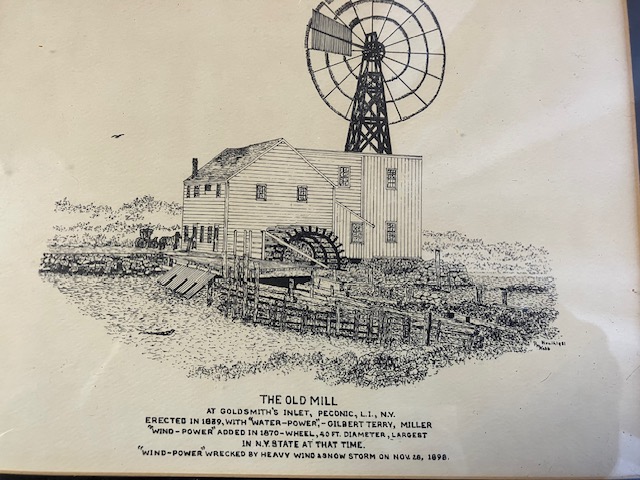
who conducted it for thirty-four years.  He widened the channel and extended and enlarged the sea walls-or piers-by vessel loads of rock from Connecticut.  As the tide would only perform during the fall of the tide from the Inlet about ten hours a day at the most and when there was a long spell of “low tides” or winter freeze the grist [grain] would pile high.  So he decided in 1870 to make use of the terrific winds and erected a new part to the mill building on top of which was a tower and a forty-foot across wind wheel, the largest of its kind at that time in the U.S.A.

photo found in A Rose of the Nineties by Rosalind Case Newell

After that on numerous occasions Mr. Terry ground over two-hundred bushels, often a bu[shel] a minute-which required some very quick work by the miller and his helper to keep the hopper up-stairs filled with grain and the bags filled with the ground feed unloaded from the spout below.  Mr. Terry built a shed on the northwest corner of the mill large enough to shelter 2 teams of farm horses if desired by the mill patrons and that on the night of Dec. 28, 1866 during a wind and snow storm of tremendous violence the like of which Mr. Terry says he has never seen since the Steamer Commodore of the New York and Stonington Line


came ashore off the Inlet-Off Faulkners Island the rudder having come out of the water-the boat broached to and getting into the trough of the sea soon rolled the smoke-stack out.  Being helpless and in a northwest wind it drifted toward the Long Island shore and then over an anchor and being immediately over a rock when it pounded until day light-being so badly torn that the water entered faster than it could be pumped out.  Some of the crew getting possession of the liquors at the bar became drunk and mutinied and when the anchor had been cast off and the steamer drifted toward ashore they seized the only boat left on board and attaching a line there to drifted toward ashore.  Early that morning Mr. Henry Squires observed on the beach several barrels of light freight, part of the deck-board of the Commodore not seeing the steamer he went home and got his team and wagon, returning he observed the row boat and looking off saw the steamer.  Hitching the boat rope to the rear axel of his wagon he pulled the boat along to abreast the steamer and the passengers were landed followed by the officers, one hundred and sixty in all were saved.  Mr. Terry’s house being the nearest it was filled to over flowing with half frozen men, women and children many of whom were immigrants.  By nine o’clock in the morning a two-horse wagon load of life preservers were piled up on his premises after serving their purpose.  A great part of the freight strewn on the shore for several miles was saved by the prompt action of the wreck master who arrived on the scene from his home in Mattituck at an early hour.  Much however was broken up and stolen.  The boilers and walking beam of the steamer could be seen near the shore for many many years. 

The Corrector, 5 January 1867, page 2


The wind mill weathered the 1888 Blizzard but collapsed under the weight of heavy wet snow and a terrific wind storm of Nov. 28, 1898. 

                   This article helped me understand the severity of the 1888 storm in the area:

16 March 1888   The Long Island Traveler, page 2


2 Dec 1898  The Long Island Traveler page 3


Numerous other wrecks have occurred in the vicinity-notably the coal barges that came ashore during the great storm that wrecked the famous wind mill of Mr. Terry on Nov. 26, 1898. The McCauley directly back of the old mill near the mouth of the Inlet,

photo found in A Rose of the Nineties by Rosalind Case Newell

the Neversink and Escort


on the other parts of the Sound Shore.  The McCauley was eventually worked off the beach costing more than it was worth to accomplish it.  Mr. Terry retired from milling and moved to Orient to become a gardener for a sister of his who owned a large farm there.  A Mr. Horsfall from ?  owned the mill later but owing to its wrecked condition

photo found in A Rose of the Nineties by Rosalind Case Newell

and lack of business, farmers were raising less and less grain and every store keeper was buying and selling grain flour and feed shipped all over the country from the big steam mills.  Mr. H. soon retired too and the old mill was left to the souvenir hunters and other tackers until the owners decided take down remains and the timbers, great beams, wheels and irons was converted into other uses.”

Final thoughts:

  • Luckily, Ella’s great granddaughter is very familiar with her handwriting and was able to verify this was written by Ella.  I believe the writing on the last page were thoughts Ella intended to add in to her writing.  Dear Great Aunt Ella, I tried to insert them where I thought appropriate and hope you’d approve.
  • Always search for newspaper accounts of important events that your ancestors may have been involved in.  When transcribing handwritten accounts, written by our ancestors, there are frequently unreadable words/phrases. Having additional accounts such as a newspaper account may help you figure out those unreadable sections.
  • Interesting and unexpected to find information about the wreck of the Macauley on a Civil War site.
  • Using census records can be helpful in verifying information and can help you understand the spelling of a name.  I found a Mr. Isaac Horsfall from England listed on the 1900 census as a Miller living in the area with his wife Fannie.
  • Getting started and asking questions can bring about amazing finds when one thing leads to another and then another.  In my experience a lot of people have things (handwritten accounts, photos, books, postcards, etc.) they may not realize they have or how important they are until you start asking questions.
  • By adding the newspaper articles, photos/postcards, and a poem the story Ella wrote becomes so much more meaningful.  Now it’s more than just the written words on a page.
  • My cousin also had a small book entitled The Old Tide-Mill On The Sound by Daniel H. Overton. Daniel wrote a poem about the Old Mill.  I thought it appropriate to end with one of the stanzas from his poem:

Time’s tides flow on resistlessly

And bear old forms away;

New tides, new methods, and new truths

Grind greater grists to-day.


I am so very thankful to Ella for being the keeper of so much family history and accounts such as this one!


Photos of Ella-possibly while her father was the Miller

If you have any corrections or additions or stories to share, I look forward to hearing them.

Enjoy the journey,

Debby

Reviewing my post entitled Labor Day-They Were Millers published 5 September 2016 I see how much additional knowledge I now have.


Tuesday, April 21, 2020

Celebrating the Life of Almeda Vincent Robinson Terry

Almeda Vincent Robinson Terry

My paternal great-great Grandmother Almeda Vincent Robinson Terry was born 182 years ago today 21 April 1838. Almeda was the fourth of nine children, and the first daughter born to Stephen and Caroline F. (Overton) Robinson probably in Riverhead, Suffolk County, New York. Almeda’s father was a farmer, based on census records.

Almeda would marry Gilbert Terry 21 October 1857 when she was 19 years old and Gilbert was 24 years old. Almeda would give birth to 5 children: Carrie (my great-grandmother), an unnamed infant daughter, Ella, Forrest and Millard.

The US Federal Census of 1860 on 30 July would show Almeda as 22 years old, born in New York, Gilbert as 27 years old, an 18 year old farm laborer John Young and Gilbert’s sister 19 year old Josephine V. Terry as living with the young couple in Mattituck, Southold town, Suffolk County, New York. Gilbert and Josephine’s mother Eliza died a year before and their father had remarried. Could this be why she is living with her brother? Josephine would later marry Charles A. Aldrich.

In 1870 Almeda and Gilbert had a daughter who lived only 19 days.

The US Federal Census of 1870 on 2 June shows Almeda as 32 and Keeping House as her occupation, Gilbert as 37 with Miller as his occupation, Carrie as 7 years old living in Southold, Suffolk County, New York. I wonder what is was like to be a Miller’s wife in Peconic in 1870?

The US Federal Census of 1880 on 21 of J shows Almeda as 42 years old, Keeping House, Gilbert as 47 years old and a Miller, Ella as 7 years old, Forrest as 3 years old and Millard as 5 months old living in Peconic, Suffolk County, New York. My great-grandmother Carrie (18 years old) was attending the Normal School for Teacher training in Newark, New Jersey at the time.

Youngest son Millard E. died at the age of 11 in Peconic, New York on 8 August 1891 of cerebral apoplexy. Millard was buried in Greenport. Cerebral apoplexy usually refers to stroke symptoms, with a sudden onset, due to bleeding into the brain. Searching local newspapers doesn’t yield any results or even a mention of Millard’s death. Was there an accident? Did he fall and hit his head and that caused his death? There is a gap in Carrie’s Letters from July 1891 until December 1891. Millard is never mentioned again in her letters.

The US Federal Census of 1900 on 6 June shows Almeda as 62 years old, 42 years married, 5 children with 3 children still living. Almeda was able to read, write and speak English. Gilbert was 67 years old Farm Laborer, and son Forest was 23 years old, Farm Laborer. Their home was Rented and they just had a house. Gilbert’s sister Josephine Petty is next on the census and must have been living next door at the time. Josephine’s first husband Charles died in 1872 and she married David Petty. David died in 1897. Josephine was listed as a Farmer by occupation. She owned her home mortgage free and had a farm. I wonder if Gilbert and Forest worked for her?

On 27 April 1907 Almeda’s husband Gilbert died at the age of 74. Gilbert’s death occurred just six months shy of their 50th Wedding Anniversary.

The US Federal Census of 1910 in May I am unable to find a listing for Almeda. I am able to find the record for children Carrie, Ella and Forrest but Almeda is not listed with any of them. I wonder if she was with family and they forgot to list her?

In the New York State Census of 1 June 1915 Almeda Terry is 77 years old and living with her daughter and family in the Village of Cutchogue, Southold Town, New York.

The US Federal Census of 1920 on 20 January shows Widow Almeda is 81 years old and living in Southold, New York with her daughter Ella (46 years old), son-in-law George Billard (49 year old Farmer), and their sons Irving (17 years old) and Ellis (15 years old).
Almeda passed away 15 October 1925 in Cutchogue, New York at the home of her daughter Ella Terry Billard. Almeda died from Apoplexy (stroke) at the age of 87 and is buried next to her husband Gilbert and their infant daughter.

I wonder about ‘Vincent’ as Almeda’s middle name. Where did that come from? Was it a typical name for a girl to have in 1838 or is she named for someone I haven’t found yet?

I am very fortunate to have the above picture of Almeda. Maybe from the 1890s?  I wonder how old she was in the picture? When I enlarge the photo (click on photo to enlarge) and look at her I see a woman who had many trials in her life, including burying 3 children and her husband, but still looks very beautiful.

Happy Birthday Almeda!

If you have any corrections or additions or stories to share I look forward to hearing them.
Enjoy the journey,
Debby


Monday, September 5, 2016

Labor Day-They Were Millers


In honor of Labor Day I decided to look at the unusual career of my great great Grandfather (Gilbert Terry) who was a Miller and found out about other Millers in the family. It’s amazing sometime what you can learn from a newspaper article and how it can enhance your family tree. 

I knew that my great-great Grandfather Gilbert Terry had run the Old Mill in Peconic, NY for many years.  When I found this newspaper article about The Old Mill I learned more about Gilbert but also about several other Terry men in the family and their connections to Mill work.

I found this article in the Cutchogue-New Suffolk Free Library.  There is a Research Room that has local genealogy information that my parents took me to one time when I was visiting back East.  In this room was a treasure trove of binders.  There was a woman (wish I had written down her name)  from the area who over the years, long before computers, would cut out articles from the local newspaper and glue them on pieces of paper by family names.  Yes, now days I can search many of the newspapers on line from my home in California because they are digitized.  The search engines are pretty good, not perfect, and you can search by date but sometimes you have no idea what is out there to search for.  I have found numerous articles that I never would have known about if not for the wonderful gift this woman left for us.

Old Mill

The Old Tide Mill

Peconic, NY

Gilbert Terry was born in 25 June 1833 to Walter Franklin Terry and Eliza Ann Tooker Terry.  Gilbert had 5 brothers and 4 sisters.
From an article entitled “He Knew Peconic Mill” published in the Long Island Forum in September 1954 I learned more specifics about my great-great-grandfather’s career.  The following excepts help tell the story;
“…in 1872 the Coxes sold their holdings there to Capt. Joshua U. Terry who, after retiring from his seafaring life in 1847, conducted the Marttituck Mill for over twenty years.”
  • I am not sure who Joshua U. Terry is and how he is related.

“The next miller at the Peconic mill after Cox and his son was Edward H. Terry who conducted it until the growing infirmities of age compelled his retirement.  He was succeeded by his brother Gilbert Terry who as the last miller there ran the Peconic mill for thirty-four years.  He gave up milling in 1902, and thereafter lived in Orient with his niece Mrs. Wilson L. Petty.” 
  • Not mentioned-that he lived with his wife Almeda Robinson Terry.  Mrs. Wilson Petty would be referring to Gilbert’s niece Annie Robinson Petty, daughter of his wife Almeada’s brother Barnabas.  I find Annie Petty and her husband Wilson living in Peconic, NY in the 1900 and 1910 census, not Orient, NY.
Gilbert Terry married Almeda V. Robinson.  They had a daughter Ella who as Mrs. George Billard lived or lives at Cutchogue.  Joshua U. Terry who ran the Mattituck mill for over twenty years, dying about 1900, was a brother of Gilbert Terry.
  • I find it interesting that they mention their daughter Ella but not Carrie Terry Warner or sons Forrest Terry and Millard Terry.  Ella was the only one alive at the time of the article though.
“In these tide-water-mills the rising tide swept into the rock-walled channel through the open gates.  As the tidewater retreated the gates would close, storing the water in the creek for use when it flowed out, turning the big water wheel.”

“During his ownership of the Peconic mill, Gilbert Terry enlarged and improved it in the early 1870’s by adding an extension on the north side and putting a windmill wheel atop a tower.  The windmill much increased the efficiency of the plant as the tide-wheel would only operate during part of the fall of the tide, or some ten hours at most.”

“With the second set of stones installed, Terry ground over 200 bushels per day on numerous occasions.  His largest grind was 300 bushels, when he worked a greater part of twenty-four hours.”
  • I can imagine how dedicated he was if he worked the greater part of 24 hours at times. 
In the 1880s they ground “wheat, corn and oats into flour, light and dark canaille, and meal for the kitchen and bran for the barn.”
  • In the 1880s ‘canaille’ meant a low grade of flour.
“ During the 1880s Gilbert was reported as saying, “We are grinding a bushel a minute, using both tide and windmill.””

“…The Inlet windmill was destroyed during a great storm on November 26 and 27, 1898.  The wheel of the mill was blown to pieces and the wreckage left hanging.  One by one the few remaining sticks dropped before the wind until the standard stood alone.”
  • According to the LI Traveler newspaper there was a blizzard with hurricane force winds known as the ‘Thanksgiving storm’.
“By this time farmers had found it more profitable to grow potatoes and cauliflower than grain.  Consequently the amount of work brought to the mill rapidly decreased until finally the water-wheel was stopped to turn no more.”
  • I also learned from this article that Walter Franklin Terry, Gilbert’s father was a miller.  That Gilbert was a miller (ran the Old Mill in Peconic, NY)  as was his brother Edward H. (who ran the Mill in Mattituck and later one in Patchogue, NY) and that Joshua Terry was also a miller.  A family of Millers-what interesting work and different from the common practice of farming.
For those of you regularly following my blog you may be interested in knowing that Gilbert Terry was the father of Carrie Terry Warner-Carrie's Letters.  See additional blog posts- Carrie's Letters.
If you have any corrections or additions or stories to share I look forward to hearing them.
Enjoy the journey,
Debby

Sunday, April 24, 2016

Trusting information in Obituaries

This week I was very fortunate to connect with a new highly probable cousin on my paternal great-grandmother’s Terry side.  As always, it’s so exciting to find someone you are probably related to who also enjoys talking about our ancestors and piecing together the information we may both have separately in order to learn more about our ancestors.  This sparked me on to look at my paternal great-great grandfather Gilbert Terry of Peconic and Orient, New York.
I started by looking at what I already knew at this point about Gilbert:
  • Gilbert was born to Walter Franklin Terry and Elizabeth Ann Tooker Terry on 25 June 1833 in Patchogue, Suffolk County, NY.  Gilbert was the 3rd of 10 children; Walter Franklin, Albert Bunce, Gilbert T., Edward Henry, Elizabeth Frances, Ira Brewster, Emily A., Josephine Virginia, Amelia and Charles.
  • Gilbert married Almeda Vincent Robinson on 21 October 1857.
  • Gilbert and Almeda had 5 children; Carrie Eliza (my great-grandmother), Ella Frances, Forrest, Millard E. and an unnamed infant daughter.
  • I know that Gilbert ran the Mill in Peconic for many years.  (More information about this in a future blog.)
  • Gilbert died on 27 April 1907 in Orient, Suffolk County, NY. and is buried beside his wife Almeda, infant daughter, sons Forrest and Millard at The New Bethany Cemetery in Mattituck, Suffolk County, NY.

Terry family stone
Terry Gilbert headstone
 
 
Gilbert death certif
 
Interesting that some information on his death certificate is incorrect.  I thought the primary cause of death was interesting.  I would have expected the primary and secondary to be the other way around.  Gilbert was actually 73 since he died about 2 months before his 74th birthday.  I also laughed at his occupation being listed as a ‘Farmer’ knowing that he had run the Peconic Mill for about 34 years.
 
Then I decided to look at an Obituary that I had and realized I actually had 3.  As I reviewed the information in each I realized that there was a variety of information and that some of the information wasn’t as accurate as I thought it would be.  Since these weren’t my first pieces of information I was surprised to see the discrepancies. 
 
Obituary 1-I believe this is from the newspaper The Long Island Traveler
“Gilbert Terry, a well known and highly esteemed citizen of Orient, died suddenly last Saturday afternoon of heart disease,  He was 78 years old.  Mr. Terry was well know in Peconic and Mattituck, where he formerly resided.  He leaves a widow and one son Forrest Terry, as well as two brothers and three sisters.  A short funeral service was conducted Tuesday at his late home; then the remains were taken to Mattituck, where services were conducted in the M. E. Church.”
 
Obituary 2-From The County Review dated 3 May 1907 page 4
“Orient
Gilbert Terry, a well-known resident of this place, died suddenly last Saturday afternoon of hear disease.  Mr. Terry was well known in Mattituck and Peconic, where he formerly lived.  He was 73 years of age.  The internment was at Mattituck on Monday afternoon.”
 
same issue page 5
“DIED
Orient, April 27-Gilbert Terry, aged 73 years.  Internment at Mattituck.”
 
Obituary 3- From the newspaper The Riverhead News dated May 4, 1907
“Baiting Hollow
Mrs. John B. Warner received word on Saturday, April 27, of the sudden death of her father, Gilbert Terry, of Orient, on that date.  Mr. Terry had been writing his daughter only a few days before his death, and was then in his usual good health.”
 
I thought it interesting in Obituary 1 that Gilbert is listed as only having 1 son and no daughters.  At the time of his death his 2 daughters, Carrie Terry Warner and Ella Terry Billard, were still living but not mentioned.  If I hadn’t known and was looking for information I would have been mislead.  Gilbert actually had 5 brothers and 4 sisters.  Perhaps the obituary is only referring to the ones still living?  I don’t have all the death dates for his siblings so I will need to follow-up on that one.
 
I wish I had that last letter she received from her father.  In some of her letters to her sister (see blog posts labeled Carrie’s letters to read more about the letters she wrote to her family) it seems that her father may have been a little disappointed in her for not visiting more often.
 
Lessons learned-Be careful!! Don’t believe everything you read and remember that an obituary may be able to give you some leads but it may also omit some valuable information as well.
 
If you have any corrections or additions or stories to share I look forward to hearing them.
 
Enjoy the journey,
Debby
Thanks, Fred for taking time to talk about our Terry Family and possible connections.  I look forward to continuing our discussions and work!