Monday, June 4, 2018

Southern California Genealogy Jamboree 2018-Friday and Saturday

The Southern California Genealogical Society does such an amazing job of pulling this Jamboree off.  This year was the 49th year they have done this.  The speakers were amazing, the venue is great and everything seems to run seamlessly, at least for us the attendees it always seems that way.  BRAVO and Thank-you to all the volunteers that pull this off!!  I know it is a tremendous job that takes hours and hours of planning and so much behind the scene work.  We do appreciate all you do!!

Friday and Saturday were the official Jamboree Days and the theme this year was Unlock Your Lineage.

image

Between Friday and Saturday I attended another 9 sessions and a workshop.  Here are some of the highlights of what I learned:

Friday began with a Breakfast Banquet and Thomas McEntee’s talk entitled How Do I Know What I Don’t Know?  Fast Tracking Your Genealogy Education.  Thomas started by reminding us that it’s OK to admit that we don’t always have the knowledge when it comes to researching and methodology.  He gave us tips on creating lists of where our knowledge gaps are so we can determine where to go to build our new bank of resources. 


                                                 Thomas MacEntee and myself

Annette Burke Lyttle’s talk was entitled Reconstruct a Life: Chasing Uncle William through the Wilds of Cyberspace.  Annette took us through online research of her Uncle William to determine his occupation in Laramie and how many wives he really had.  She demonstrated the techniques she used for answering her questions by using Wikis, Cyndi’s List, Google, Online Trees, digitized books and newspapers.  I think I prefer learning new techniques when they are demonstrated through the use of a case study.

Lisa Louise Cooke’s talk was entitled Reconstruct Your Ancestor’s World with Google.  Lisa is a great presenter who is very enthusiastic and easy to listen to.  She showed us several places beyond the typical Google search (such as; Google Books, Google Scholar, Google Patents, YouTube and Google Earth Pro) where information can be found about your ancestors that make your stories much richer.  I had heard Lisa’s talk last year about Google and YouTube and added some interesting clips (click on the links) to my post entitled Recording A Family Thanksgiving Tradition which I think made the story a lot more interesting.

Friday afternoon I took a 4 hour workshop with Blaine Bettinger entitled Visual Phasing Workshop.  Blaine walked us through how you can use your sibling’s DNA to reconstruct your Grandparents DNA.  WOW!  Can you imagine that is even possible.  After he walked us through the painstaking manual process for comparing the segments of chromosomes to make this determination he thankfully showed us a computer program that Steven Fox developed that makes this entire process soooo much easier.  The workshop was a pretty intense 4 hours but I was able to keep up, more or less,  and I understood why Blaine felt it was important for us to understand the process.  We all definitely needed a break after that.


with Blaine 2018Myself, Blaine Bettinger and Diane Gould Hall

Saturday:
Craig Roberts Scott’s talk entitled Civil War Medical Records demonstrated his depth of knowledge on the subject.  Craig took us through NARA (National Archives and Records Administration) finding aids for medical records that are often rich in genealogical information.  I had thought that the records I have on my ancestors who fought in the Civil War were complete and now I know I have a whole new untapped source to look at.

Lisa Louise Cooke had a Mini Power Session at the Genealogy Gems booth in the Exhibit Hall where she talked about 4 great apps that can help you with your story telling.  Several of them I will need to try very soon.
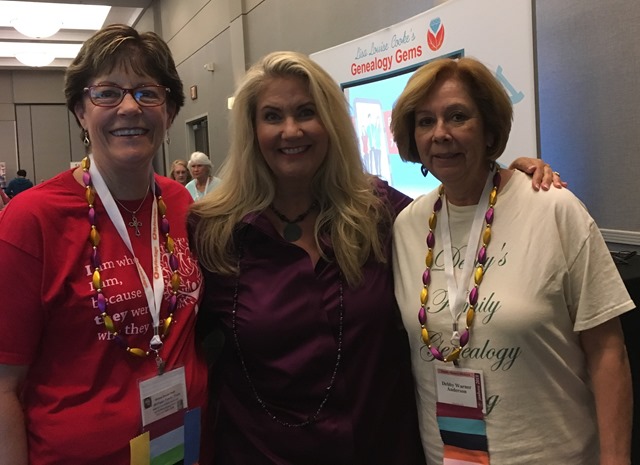
Diane, Lisa and I 2018
Diane Gould Hall, Lisa Louise Cooke and myself

I stopped by the Mayflower Society booth in the Exhibit Hall.  I have sent in my application to become a member of the Mayflower Society.  I asked if they knew of anyone who makes period dress for the Pilgrims and they informed me that in 2020 for the 400th Anniversary of the Mayflower the Society may be marching in the Rose Parade.  Sounds exciting!
Mayflower booth 2018

Annette Burke Lyttle’s talk entitled How Research Plans Can Up Your Genealogical Game really made me think about my ‘research plans’.  I have listened to discussions previously on Research Plans and have used them at times but I think you need to hear some topics over again until it really resonates for you.  Annette discussed coming up with that specific research question and how to identify sources that are available that my provide you with answers.  My big take away from this when I am researching in a new area is not to just hit the SEARCH button but to research all the possible sources of information in an area about a topic before I hit the Search button.  I kept thinking about my post on Mary ? King.  I have no idea whether she was born in Germany or in Pennsylvania.  The other problem is what records are even available to search in Pennsylvania in 1814?  Definitely a technique I will try with this question.

Thomas MacEntee’s talk entitled Secrets of the US Federal Census: How did Enumeration Really Work raised some really good questions about our probably number one source of information when we are researching.  Thomas, who is a great speaker, talked about how each of the Census’ had their own quirks, sometimes hidden information and the different ways to access the census data.  I use the census so much that this will really cause me to go back and look at the information in them with new eyes.  This was a great way to end Jamboree.


Some time with friends and fellow bloggers
IMG_0479

There were several talks I would have liked to have heard but just not enough time in the day.  I was able to buy and download the talks for a fee.  Another great perk of the conference.  If you were unable to attend but think you’d like to investigate some of the sessions I attended be sure to go to Southern California Genealogy Society website and click on Jamboree and Buy Past Recordings to order yours.

Jamboree 2018
I was very pleased to get my first set of Blogger Beads on Friday night from Elizabeth Swanay O’Neal and the GeneaBloggers Tribe.

If you have any corrections or additions or stories to share I look forward to hearing them.
Enjoy the journey,
Debby
image

Sunday, June 3, 2018

Southern California Genealogy Jamboree 2018-Thursday

image

WOW!!  Three days packed with genealogy learning, connecting with old friends and making new friends.  It is always so amazing to be in an environment were there are over a thousand people who share the same passion you do -all in one place at one time.  The energy level was so high for all three days.  I am so glad to have today to reflect and relax. 

The Southern California Genealogical Society does such an amazing job of pulling this Jamboree off.  This year was the 49th year they have done this.  The speakers were amazing, the venue is great and everything seems to run seamlessly, at least for us the attendees is always seems that way.  BRAVO and Thank-you to all the volunteers that pull this off!!  I know it is a tremendous job that takes hours and hours of planning and so much behind the scene work.  We do appreciate all you do!!

Fellow blogger and good friend Diane Gould Hall and I drove up to Burbank on Wednesday night to avoid much of the LA traffic. 

Thursday was a special additional day where you could take part in one of two special tracks for the day –a course of DNA study entitled Link through DNA or a family history writing day entitled Love Your Family Legends.  I choose Love Your Family Legends because I want to be able to write more interesting stories about the information I have learned about my ancestors. 

image

Here are some of my many great experiences for Thursday:

Jill Morelli’s talk entitled Just Do It! Self-Publishing Your Family History gave some really good information and tips about self-publishing and led me to believe I really can finally get my great grandmother’s over 100 letters from 1880-1910 published (see posts re Carrie’s Letters).

Lisa A. Alzo’s talk entitled Show, Don’t Tell: Creative Non-Fiction Writing for Genealogists discussed tips and techniques about how to share the factual information in more compelling and interesting ways so we can actually feel like we are walking in our ancestors’ shoes.  After this session I happened to see fellow blogger and friend Randy Seaver and told him I feel like I should go back and rewrite all my previous blog posts to make them more interesting…lol.  I can only hope my future posts will be more interesting.

Andrew Lee’s talk entitled Writing Compelling Family Stories took us through the understanding of basic story types, defining the basic story and the writing process. He left us with “A story is more than just a set of facts, a compelling story will transport the reader to the time and place and make him an observer to the events described.”  I think I need to have this as a sticky note posted in my work area to remember whenever I am writing a family story.

Crista and Susan Cowan ‘s talk entitled Writing Fascinating Family History One Story at a Time reminded us of the importance of writing down our own stories.  While we are so involved in telling other’s stories we forget about the importance of telling our own stories.  Mother and daughter team led us in a great fun writing activity where we got started writing our own stories.

Maureen Taylor’s talk entitled Photo Stories: How to Tell the Tales in Your Pictures showed us how to look beyond the person in the photo as we so often forget to do.  Even if you are lucky enough to know the names of the people in the photo there is so much additional information you can learn about their lives by carefully looking at the rest of the photo.  I used a photo my cousin Rebecca had shared with me of her great grandmother Ella Billard Terry riding in a horse and buggy that I will discuss in a future blog post.

Thursday night Diane and I decided to attend a banquet dinner where Diane Southard was the guest speaker.  Her talk entitled Rewriting History with DNA, Two Mindy’s, a Will and Country Music was an interesting tale of paper and DNA research to find answers to long asked questions and new family.


Stay tuned for information about Friday and Saturday’s classes.  If you have never been to Jamboree consider going next year for the 50th Birthday Bash!
image_thumb

If you have any corrections or additions or stories to share I look forward to hearing them.
Enjoy the journey,
Debby

Monday, May 28, 2018

Mary E. _ King

One of my paternal 3x great-grandmothers was Mary  E. _ King.  If I trace back on my paternal side this would be George Washington King’s father Louis’ mother. 
image
What have I been able to find out about Mary and can I figure out where she was born?  I have a lot of questions about Mary.

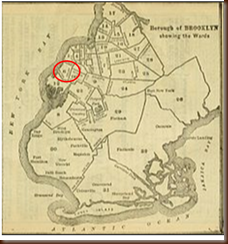
I first find Mary in the 1850 US Federal Census as living on the 2nd day of August 1850 in Brooklyn Ward 6.  Mary was married to Theodore King (see post Theodore King or Should I say Theodor Konig?) She was listed as 34 years old and her birthplace was listed as Germany.  She did not have an occupation listed and was listed as being unable to read or write.  At the time Mary and Theodore had 5 children: Catherine (15), Jacob (11), Louis (8) my 2x great grandfather, Mary (6) and Caroline (4).  All the children were listed as having been born in New York.
image
1850 Wards of Brooklyn Map from Wikipedia

New York State Census 1855.  On 23 June 1855 date Mary and her family is living in Brooklyn City, Ward 12, Election District 1, Kings County, New York.  Mary is listed as 37 years old and a birthplace of Pennsylvania.  She was widowed with an occupation of Wash Woman.  She had lived in the City for 12 years.  Jacob, Louis, Mary and Caroline were living with her.  Was Catherine married or had she passed away along with her father Theodore?  This census lists Jacob as being born in PA.  Hmm…did Mary and Theodore marry in PA?

New York State Census 1865.  On 1 June 1865 Mary was living in Brooklyn, Kings County, New York.  She was listed as being 48 years old, birthplace- Pennsylvania. Of how many children the parent of -7.  Number of times married –1.  Widowed.  She was living with Caroline (18), a Seamstress and Single.  They were living in a 2 family dwelling.  The other family was the Daniel and Catherine Lewis Family with their 4 children.  Interesting because the wife was named Catherine and the age fits that perhaps she was Mary’s daughter??  I’m aware of 5 children, so, who were the other 2?

US Federal Census 1870.  On 17 June Mary was living in Brooklyn Ward 12, Kings County, New York.  Mary was 55 years old, birthplace – PA.  Occupation was Keeping House.  Mary was living with her sons Jacob (30) and Louis (28).  They were living in a 2 family dwelling.  Mary is again living in the same house as Daniel and Catherine Lewis and their 4 children.

According to the 1870 Brooklyn City Directory Mary lived at 54 Wolcott in Brooklyn.
New York State Census 1875.  On 1 June 1875 Mary was living in Brooklyn Ward 12, Election District 2, Kings County, New York.  She was 58 years old, a Housekeeper, and widowed.  Mary was living with her son Jacob (39).  They were living in a 2 family brick dwelling.  Mary is again living in the same house as Daniel and Catherine Lewis and their 3 children.

I was unable to locate Mary in the 1880 US Federal Census.

Mary died on 6 August 1890 at 14 1st Avenue (on the second floor) in Brooklyn, Kings County, New York and is buried in Greenwood cemetery with her great granddaughter Louisa King.  Mary was about 70 years old at her death.  Her cause of death is listed as Old Age and Neuralgia.  I wonder if she was living at the time of her death with one of her children?  I noticed Mary’s death certificate was presented to her daughter-in-law Sarah King, my 2x great grandmother and the wife of Louis King who had died 3 months before his mother.  According to Louis’ death certificate he was living at 14 1st Avenue when he died, so, Mary died at the home of her daughter-in-law.


I was able to locate a lot of information about Mary but still have many questions.  From the census record I would guess, and still need to research, that: 
  • Mary was born about 1816—18.  I am guessing in PA since that is listed on more of the census records then Germany is. So, I still don’t know where she was born.
  • Mary and Theodore married about 1834 due to the birthdate of their oldest child Catherine.  Since I see Catherine listed many times in census records as having been born in Pennsylvania I am guessing that is where Theodore and Mary met and were married?
  • Mary came to Brooklyn in the 1840s is my best guess?  Catherine is reported to be born in PA as is her brother Jacob on some of the census records.
  • What was Mary’s maiden name and who were her parents?

With further digging I was able to determine that Catherine King Lewis was Mary and Theodore’s daughter as I had suspected.  Now I know her married name as well.

If you have any corrections or additions or stories to share I look forward to hearing them.
Enjoy the journey,

Debby


Sunday, May 20, 2018

Sunday Obituary-Jacob Hamman

In a previous post entitled My First Naturalization Papers-Jacob Hamman written in April 2017 I wrote about what I knew at the time about my maternal 2x great grandfather Jacob Hamman.  I had some vague information about the family but I had Jacob’s naturalization papers.  Later in 2017 I would write about Jacob’s wife Kate in posts entitled What’s the Correct Information? and Amanuensis Monday-A Will but…Whose Signature is That?.  Even after all this information…I still had questions.  I still had missing pieces about Jacob.  I wasn’t sure of his birthdate or when he married Kate or even when he died.  That was until I finally found his obituary in the Remsen Enterprise newspaper on page 5 which was published in Remsen, Iowa on Friday, November 23rd, 1900.  Will this have some answers for me?

Hamman Jacob 1900 obit

Transcription:                                                             "Death of Jacob Hamman
Jacob Hammon died at this home in Fredonia township, very suddenly Sunday evening, November 18, 1900 of asthma after an illness of but a few hours.
Deceased was sixty-four years old and was born at Hesper, Granduchy, Luxembourg on the 25th day of August 1836. He came to America when a young man thirty six years ago.  He lived at first in Dubuque county where he engaged in farming. He was married thirty-one years ago to Katerina Hein, who still survives as his widow.
He came to Plymouth county twenty-one years ago, and after some time bought the place he owned by him until his death,
He leaves a family consisting of his widow and nine children: Nicolas, Lena Mauer, of Minn., Henry, Peter, Mike, John, Joe, Maggie and Francis all living at home or hear Remsen except Mrs. Mauer.
The funeral took place at ten o’clock on Wednesday morning, Rev. Father Schulte officiating.
The deceased was an honorable and upright man and was much respected by all the citizens of the community where he has lived so long, and who sincerely mourn his loss, and extend sympathy to his bereaved family."

What I’ve learned from his obituary:

I knew from Jacob’s Naturalization records that he was from Luxembourg but now I have a location: Hesper.  ‘Hesper’ in Luxembourgish and ‘Hesperingen’ in German.  Hesper is located southeast of Luxembourg City.

I now know that Jacob, according to his obituary was born on August 25th, 1836.

I now know that Jacob came to America about 1864.

I now know that Jacob and Kate were married about 1869.  Although in 1908 in Kate’s obituary it says she had been married for 40 years to Jacob.  So they may have been married 1860-1869?  Hmm, were they married in Luxembourg or America? 

I now know that Kate was about 6-7 years younger than her husband.

I believe Jacob and Kate had 12 children.  I now know there were 9 children living when Jacob died and 7 children living when Kate died 8 years later.

I now know that Jacob owned land when he died so I can search for land records.

I now know a death date, place and cause of death for Jacob: November 18th, 1900 Fredonia, Plymouth County Iowa and he died of asthma.

I now also know that Jacob was an “honorable and upright man and was much respected by all the citizens of the community where he has lived so long, and who sincerely mourn his loss”.  This is information I definitely cherish!  

By finding this obituary there was so much new information that I now have.  This was a GREAT find!

If you have any corrections or additions or stories to share I look forward to hearing them.
Enjoy the journey,
Debby

Saturday, May 19, 2018

Griffith’s Valuation-McKenna Family

After my last posts Researching the Land of My Ancestors-County Tyronne, Ireland and Felice and Sarah McKenna of County Tyronne, Ireland  I decided to see if I could find anything about them in Griffith’s Valuation. 

First, I need to understand what these records are:
Many Irish records were lost in 1922 when the Public Records Office burned, so, surviving tax records are particularly significant to my Irish research.  A valuation of taxable property in every parish in Ireland, called Griffith's Primary Valuation, was done between 1848 and 1864.

In 1825 a man named Griffith was appointed by the British Government to carry out a boundary survey of Ireland (Ireland is about the size of the state of Indiana). He was to mark the boundaries of every county, barony, civil parish and townland in preparation for the first Ordnance Survey.  Griffith’s Valuation in County Tyrone was completed on 13 July 1860. 

The valuation records list the name of the head of the household, the name of the landowner ('immediate lessor'), the acreage of the plot, the value of the property, and the amount of tax assessed. The tax based on the property valuation was used to support the poor.  Valuations were then made throughout Ireland approximately every decade.
So, knowing the place and date of my ancestor’s residence will be extremely helpful in my Irish research.  What can I find?

I found the following 2 records for 1860 in the Parish of Clonfeacle, County Tyrone:      (click on individual images to enlarge)

image
image

In the image on the left I found a listing for Francis McKenna (I believe this is Susan’s father) living on Killyman Street in the village of Moy.  (See the red box.)  Francis was leasing a House, office and yard from Maria Martin.  Francis’ total annual Valuation of ratable property was 4 British Pounds.

In the image on the right I found a listing for Felix McKenna (I believe this is Susan’s brother) living in the nearby area of Anagasna Glebe. (See the red box.)  Felix was leasing 2 pieces of property from Rev. Joseph Stevenson.  The first listing contained a house on the property.  The size of this property with the house was 4 Acres, 1 Rood and 10 Perches.  [30 1/4 square yards = perch, 40 perches = rood and 4 roods = acre]  This land was valued at 3 British Pounds, 5 Shillings.  The building on the land was valued at 10 Shillings.  The second piece of property was probably a field of agricultural or grazing land.  This size of this land was 1 Acre, 1 Rood and 15 Perches. The value of this land was 1 British Pound.  Felix’s total annual Valuation of ratable property was 4 British Pounds, 15 Shillings.

Some thoughts to ponder:
  • In the same area that Felix lived there are listings for 11 men with the surname Hughes (underlined in green) as well as other McKennas.  My ancestor Susan McKenna married Patrick Hughes.  Could these Hughes be siblings/family of Patrick?
  • I believe I have found a US Federal Census record for Susan and Patrick Hughes in New York City in 1850 but I wasn’t 100% sure I had the right family.  Living with them according to the census was a Susan Quinn of about the same age as my Susan.  I see there is a Patrick Quinn living in the same area as Felix McKenna, underlined in yellow on the right above.  Could this be family of Susan Quinn?  Was Susan Quinn a close friend of Susan McKenna?  Coincidence??
Even though my ancestors Susan McKenna and Patrick Hughes left Ireland around the late 1840s this gives me information about her father Francis and her brother Felix.  Since Felix appeared to stay in Ireland perhaps I can find descendants of his in Ireland one day.  Oh, so much more research to do…

If you have any corrections or additions or stories to share I look forward to hearing them.
Enjoy the journey,
Debby

Monday, May 7, 2018

Felice and Sarah McKenna of County Tyrone, Ireland

As I was researching Susan McKenna Hughes (see post The Luck ‘o The Irish…Perhaps), I found out information about Susan’s siblings and her parents’ names-Felice and Susan McKeena.  Another generation back … and in Ireland.  YEA!!  I believe my paternal fourth great-grandparents (on my grandmother Agnes’ side of the family) were from County Tyrone, Ireland.  I wanted to see what I could find out about Felice and Sarah.

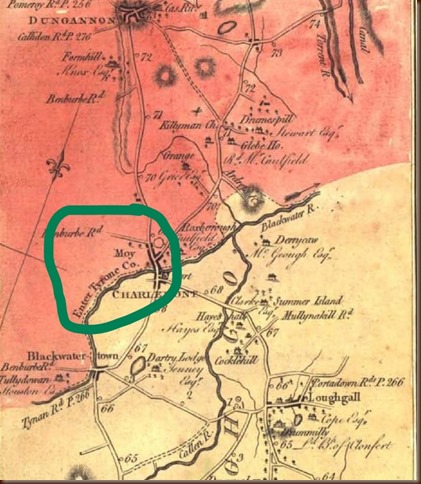
I always like to have maps handy when I am researching a place that I have never been to.  Here is one I found from 1777 that shows Moy, Clonfeacle, Tyronne, Ireland:

Tyrone is the County, Clonfeacle is a Civil Parish, Moy is the Village.  (See previous post Researching the Land of My Ancestors-County Tyrone, Ireland for additional information).  This family is located in the same area as where Susan was married.  I believe I am on the right track with this family but am not 100% sure. 

Here’s what I was able to find out:
Francis McKenna was baptized on 8 September 1799 in Armagh, Ireland.  Father-Francis  and Mother-Cate Hollyday.

Felice and Sarah McKenna had 3 children, that I know of.
  • Fel McKenna was baptized on 9 January 1817 in Clonfeacle, County Tyrone, Ireland.  Parents- Fel and Sar McKenna
    • Married Sarah Coleman on 9 September 1858 in Clonfeacle, County Tyrone, Ireland.  Perhaps a second marriage?
              Francisco and Sarah had:
      • a daughter Maria McKenna baptized in the Parish of Moy, County Tyrone, Ireland
      • a son Joannis (John) McKenna baptized in the Parish of Moy, County Tyrone, Ireland
      • a son Patrick McKenna
      • a son Thomas McKenna
  • Susan Helen McKenna was baptized on 2 January 1820 in Clonfeacle, County Tyrone, Ireland.  Parents- Felix and Sarah McKenna.  Susan is my 3rd great-grandmother who immigrated to America (New York City) with her husband Patrick Hughes after their wedding in Clonfeacle, County Tyrone, Ireland on 8 November 1846.
  • Ellen McKenna was baptized on 3 April 1822 in Clonfeacle, County Tyrone, Ireland.  Parents- Felice and Sarah McKenna

Francis McKenna died in 1864 at the age of 67 in Tyrone, Ireland in the Registration District of Dungannon.  This is the right area and age so I am hoping this is the same man.  I need to see if I can get a copy of his death registration to see if there is any additional information to prove this is the right man.
      When researching ‘Felix, Felice and Francis’ I found them all to be variations of the same name.


Many of the Irish used ‘Naming Patterns’ when naming their children during the 1700 and 1800s.  These might help me go back yet another generation.
     1st son named after Paternal Grandfather                                     1st daughter named after Maternal Grandmother
      2nd son                    Maternal Grandfather                                    2nd daughter                    Paternal Grandmother
      3rd son                     Father                                                            3rd daughter                     Mother
      4th son                     Father’s oldest brother

If naming patterns were used by this family then I would guess that Fel, is the oldest son and his paternal grandfather would also be named Felice/Fel/Francis. That fits with the Baptismal Record for Francis.  If Susan is the oldest daughter then I would believe that her maternal grandmother would have also been named Susan.  If Ellen is the 2nd daughter then I would believe that her paternal Grandmother was also named Ellen.  Hmm.. that doesn’t fit with Francis’ mother being Cate on the Baptismal Record.  There could have been other children that died at a young age that would throw this theory out the window as well.  Well, guess I have to do more research.


I found a wonderful song about Moy that can be listened to on YouTube called The Village That They Call ‘The Moy’.  (Click on the title to listen on YouTube.)  Or the lyrics and the song can be found at https://listamlet.com/the-village-that-they-call-the-moy/.  Happy listening!

If you have any corrections or additions or stories to share I look forward to hearing them.
Enjoy the journey,
Debby


Sunday, May 6, 2018

Researching the Land of My Ancestors-County Tyrone, Ireland

I believe I have correctly traced back my paternal 3rd great grandparents Patrick Hughes and Susan McKeena Hughes to County Tyrone, Ireland in the mid-1800s.  Specifically their Roman Catholic marriage record is from Moy, Confeacle, Tyrone, Ireland (see post The Luck ‘O the Irish…Perhaps…).  I started gathering some information on Susan’s family and realized there were some terms I needed to understand first.  So I started researching about the history and land of Ireland in this time period so I can try and determine what life might have been like for my ancestors. 

image


New land and area terms to understand:

Province- largest land areas. There are 4 provinces in Ireland.  County Tyrone is in the Province of Ulster.
County- large areas of land divided into civil parishes and parishes are then divided into townlands.  There are 32 counties in Ireland.  26 are in the Irish Republic and 6 are in the North of Ireland and are part of the United Kingdom. Tyrone was established in 1585 and has an area of about 1200 square miles.  Tyrone is the largest county in Northern Ireland and it connects to the counties of Fermanagh, Monaghan, Armagh, Londonderry, Donegal Antrim.
Barony- area of land that contained a larger number of townlands than a parish.  Was used for collection of taxes but is a term no longer used.  (Baronies are in red on the following map)
Parish- a smaller area of land with origins in old Gaelic territorial divisions.  A Parish could refer to Catholic Church parishes, Protestant Church parishes or Civil parishes.  (Parishes are in black on the following map)
image

Diocese-  comprised of several parishes.  These are church administrative areas under the control of a Bishop.  Different parts of County Tyrone fall under the Roman Catholic Dioceses of Armagh, Clogher, and Derry.
Townland or Village- one of the smallest land divisions in Ireland.  They can range in size from 1-2 acres to thousands of acres but most are hundreds of acres.

The ones I am currently interested in from the marriage of Patrick and Susan are:
  • Moy (from Irish: an Maigh, meaning "the plain") is a large village and townland about 5 miles southeast of Dungannon and beside the smaller village of Charlemont.  Charlemont is on the east bank of the River Blackwater and Moy on the west; the two are joined by Charlemont Bridge. The river is also the boundary between County Tyrone and County Armagh.
  • Clonfeacle is a Civil Parish and a Town.  Clonfeacle is split across the baronies of Dungannon Lower and Dungammon Middle in County Tyrone

Some additional information:

The Great Famine or Great Hunger was a period of mass starvation, disease, and emigration in Ireland from 1845 and 1849 due to the potato blight.  In Ireland there were over a million deaths.  Population fell by 20–25% due to mortality during this time period and emigration.  There had been an Irish Famine in 1740-1 and there would be another Famine in 1879.  This is when Patrick and Susan left for America.
I also recently read the book Tipperary: A Novel by Frank Delaney.  Frank Delaney has written several great books about Ireland.  This one really gave me a feel for the political climate in Ireland in the late 1800s and early 1900s.  I always like to read non-fiction or historical fiction about an area to get a feel for what was happening at the time of the lives of my ancestors.

I still have so much to learn but this is a good start.  Donna Moughty, who I have listened to several times at conferences and have consulted with, speaks frequently on Irish research and has a blog entitled Donna’s Irish Genealogy Resources.  Donna also has a set of 3 Guides that are also very helpful and constantly at my side when I am researching my Irish Ancestors.  Donna and her information has been a great help!  It can be overwhelming researching in another country with so many new terms and resources that you are unfamiliar with.  Don’t forget to do your research on the area as you research your ancestors!

If you have any corrections or additions or stories to share I look forward to hearing them.
Enjoy the journey,
Debby